











Introduction
Last month the government published its first Road Safety Strategy in over a decade. Alongside the growth of electric vehicles (EV) and advanced driver-assistance systems (ADAS), we now face the added complexity of e-scooters and e-bikes, in varying states of legality, with automated vehicle (AV) passenger service trials expected as early as Spring 2026.
There are clear links with two recent publications – the FCA Report on Motor Claims and the Motor Insurance Taskforce report - both driven by concerns over rising the motor insurance costs, particularly for young and older drivers. The ABI 10-point road map to reduce motor premiums has also clearly influenced the discussion. In our view the Road Safety Strategy is to be welcomed, containing sensible measures aimed at reducing the number and severity of accidents. This in turn should reduce claims numbers, claims costs and ultimately premiums. Rather than simply list the proposals, we have considered how specific measures may impact insurers and the extent to which they are likely to achieve their intended outcome.
Behind all this of course is the human picture where any measures, which reduce the numbers of killed and seriously injured road users (KSIs) must be welcomed. Change is however subject to resistance: this was the case in the 1960's with drink drive laws and later with mandatory seat belt use. Social media has already seen push back on the drink drive reduction, citing the potential effect on rural pubs and civil liberties. Then there is of course the political landscape, will Labour have time to bring these ideas to fruition given a possible change of government in 2029?
While this strategy applies to England & Wales, it is worth noting the Road Safety Framework to 2030 in Scotland has similar aims focusing on vulnerable road users, improved vehicle safety and a shared long-term ambition for significant reductions in deaths and serious injuries.
In Northern Ireland just last week we heard the news that they too are putting road safety at the top of their agenda and will be the first part of the UK to introduce a graduated driving licence for younger people from October 1st.
Background: The numbers
There had been a general trend towards a downward trajectory in terms of KSIs year by year, but this has sadly plateaued (see table below). Although the numbers are slightly skewed by the pandemic, it is clear the last 5-6 years have not seen reductions we might have expected given technological advancements. Government figures show that there were 29,896 killed or seriously injured KSI casualties in 2025, down only 1% from 2024.
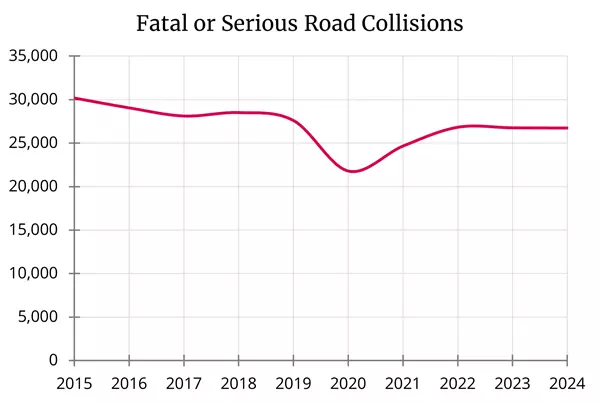
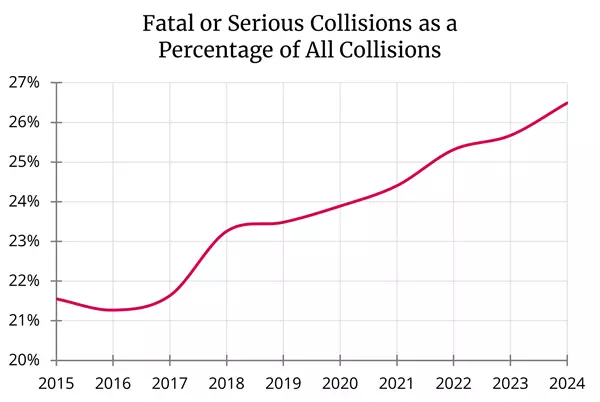
Despite the overall number of accidents falling, in percentage terms compared to accidents overall, KSIs are increasing.
Key recommendations of the Road Safety Strategy
- Overarching aim is for 65% reduction in deaths and serious injuries by 2035.
- Minimum 3/6 month learning period for new drivers.
- Lowering drink drive levels
- Mandatory eye and cognitive tests for over 70s
- Review of penalties for drink and drug driving
- Penalty points for failing to wear a seat belt or failing to ensure child use.
- Tougher action on uninsured, unlicenced driving and without valid MOT.
- Direct reports to DVLA of relevant conditions by health professional
- Enhanced motorcycle training
- Using data from connected vehicles to inform on accident occurrence
- Ensuring all new vehicles have 18 advanced safety features fitted.
Minimum learning period for new drivers
The facts speak for themselves: 17–24-year-olds possess 6% of licences yet were involved in 24% of KSIs in 2024. The longer learning period should enable learner drivers to have more experience while supervised in a variety of road and weather conditions.
'Our experience of handling claims arising from fatal and serious road accidents supports the data that a disproportionate number of the drivers are below the age of 24 and in many cases have only recently passed their test. This cohort of drivers contains a small number that overestimate their ability to drive at speed and underestimate stopping distances or the movement of pedestrians and other vehicles. Additional time in training will help fill that knowledge gap but is unlikely to stop those that choose to be reckless.” Michael Renshaw, Major Injury Partner, DWF.
Graduated Driver Licensing (GDL) will be introduced in Northern Ireland from October this year. This will apply to all new drivers and will ensure a six month wait before taking a test plus restrictions on nighttime driving and the number of passengers allowed. It will be interesting to monitor the statistics over time in this jurisdiction to see if there is a significant impact on KSIs.
Further afield, in November 2025, EU reforms introduced a higher standard of testing where new drivers now have to have eyesight & cardiovascular medical checks, a probationary period of at least two years with stricter rules and sanctions, and 17-year-old drivers have to be accompanied by an experienced adult until they are 18.
Assessing older drivers' ability to drive
There are now over 60% more drivers aged 70+ on UK roads than a decade ago, 15% of all license holders. In 2024 22% of fatalities and 8% of casualties were aged 70 years old and over. Government data collected on older drivers (defined as over 70) shows they are more likely to have accidents at junctions, in daylight hours, for observational reasons and with pedestrians. Further, 25-30% of pedestrian KSIs involve a collision with an older driver, well out of proportion with the driving miles of older drivers. The government produces an annual factsheet which can be accessed here.
The proposal is for compulsory eye tests and cognitive testing for over 70s. Police will also conduct more roadside checks where these issues may be relevant and healthcare professionals are to be encouraged to inform the DVLA of relevant conditions if appropriate.
Reducing drink drive limits
The current limit of 35 micrograms of alcohol per 100 millilitres of breath is the highest in Europe and has remained unchanged since 1967. In 2023, 1 in 6 fatalities resulted from drink drive collisions. Lowering the limit seems a sensible step to reduce alcohol related accidents and the knock-on effect for insurers in terms of passenger claims. Another related area that the government is looking at is preventing vehicles from being started unless a breath test is taken (alcohol interlock), for repeat drink-driving offenders.
Sarah Mir, Partner in Catastrophic Injury at DWF commented:
“The UK Road Safety Strategy (2025–2035) makes it clear that any alcohol impairs driving ability and sets a national target to halve deaths and serious injuries by 2035 through stricter enforcement and lower drink-drive limits. The Strategy emphasises that impairment begins well below previous thresholds, reinforcing that even modest consumption creates foreseeable danger.
Under the Law Reform (Contributory Negligence) Act 1945, the court applies an objective test: what would a reasonable person have done in the circumstances? Reducing the drink-drive limit does not change that test, but it broadens the scope of foreseeability—did the passenger know, or ought they to have known, that the driver had consumed too much to drive safely?
A lower threshold supports arguments that even modest impairment creates a foreseeable risk, enabling insurers to advance contributory negligence submissions. It reinforces the principle that any voluntary acceptance of a ride under those conditions meets the standard for contributory negligence. Insurers should consider citing the UK Road Safety Strategy when making such arguments.”
Focus on vulnerable road users
Vulnerable road users, such as cyclists, motorcyclists and pedestrians, are another area of concern for insurers; these cases tend to involve bony injuries rather than the tariff-based whiplash, making even modest claims expensive for insurers. Motorcyclists make up just 1% of road traffic but 21% of deaths and 12% of all road casualties and are 40 times more likely to be involved in a KSI incident than a car driver.
The government is looking at enhanced training courses and reforms to the testing and licensing regime for motorcyclist. Project PRIME is aimed at improving safety on rural roads for motorcyclists, using special road markings and signage to help them navigate sharp bends. Trials of this in Scotland have been promising and it looks likely to be replicated in England and Wales.
There seems to be a lack of driver awareness of the new hierarchy of road users created by the changes to the Highway code in 2022. The hierarchy places more duties on drivers to give way and anticipate the actions of cyclists and pedestrians. According to research carried out by the AA, as of August 2024, 42% of drivers were unaware of the changes and three out of ten had not looked at the Highway Code since they passed their test. A public awareness campaign alongside the new strategy would have a greater impact.
Tougher action on uninsured, unlicenced driving and without valid MOT
Uninsured driving is a huge cost to the insurance industry, not least as all major insurers make payments to the MIB fund to cover incidents arising, at a cost of around £30 per customer. Driving without a licence or a valid MOT continues to cause issues with the potential increase of unsafe cars and drivers on the roads. Unsurprisingly, both rise in times of austerity.
Increasing fines, penalties and encouraging collaboration and information sharing between the Police, DVSA and the Motor Insurers’ Bureau should reduce the overall costs to the industry. An excellent example of this being the 2021 'National Tutelage Service' where the MIB wrote to uninsured vehicle owners traced on ANPR to advise there was no insurance in place – 78% of 700,000 recipients became compliant after notification. This will be expanded to include MOT data from the DVSA.
Use of data, connected vehicles and technology
Modern connected vehicles that collect reams of data presents an opportunity to learn from collisions and prevent future accidents. At DWF we have long championed data analytics and telematics as levers to reduce fraud and determine liability. Benedict Harper-Drew, Telematics Specialist, DWF comments as follows: -
"I am very pleased to see that vehicle data including telematics data will be used to proactively improve road safety in the DfT's proposals. The fact that 9 out of 10 road collisions in the UK has human error as a contributing factor means that data including telematics data should provide insights into how reduce these risks. DWF's specialist telematics team has been helping Clients reactively protect themselves after a collision using their data, so I am certain proactive measures that is data led will be equally beneficial."
Existing technology, such as Advanced Driver Assistance Systems (ADAS) needs to be fully understood, utilised and collaboration with stakeholders will be key to maximise benefits. If vehicles possess the ability to harness this data, then consideration should be given to whether the use of ADAS should be compulsory? Several industry events including the ABI Motor Conference in the summer of 2025 discussed the practice of ADAS features being 'turned off' by drivers on a regular basis. Should this be prevented or on the other hand is the ADAS function in itself a risk if unable to adapt to differing road conditions. As the government has identified, this area needs to be looked into further to measure the risks accurately.
Angela Hanmore, Partner and lead of the DWF Autonomous and Electric Vehicles Group said as follows:
"Recent research found public attitudes improved significantly when the safety benefits of AV's were highlighted. In 2024, research by HPI, a supplier of technology driven data solutions found that only 22% of UK road users would trust a driverless car. Support for autonomous vehicles (AVs) rose from under 50% to nearly 75% when respondents to a survey by DG Cities 'Safety First? Understanding Acceptance of Automated Vehicles were told that AVs could reduce serious injuries and fatalities".
Turning to vehicle manufacture, the government is keen to establish 18 safety features as compulsory for new design vehicles, including emergency lane keeping, reversing motion awareness, drowsiness and attention warning and advanced distraction warning. The UK should also be able to use their position on the board of The European New Car Assessment Programme to influence safety features of new designs.
Bus and coach
Whilst a comparatively small sector, accounting for roughly 1% of vehicle miles travelled, 2-3% of fatalities involve buses or coaches so improvements in this area will have an impact. Let us have a look at the composition of road traffic taking cars out of the equation:
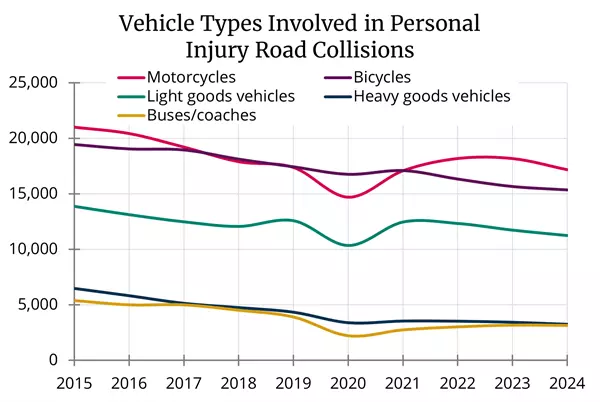
The Road Safety Strategy reframes bus safety as a matter of systems and governance rather than simply individual driver behaviour. While it does not introduce immediate new legal duties for operators, it places buses within the Safe System approach and treats the sector as a priority for structured intervention. Central to this is the formal role given to the Bus Centre of Excellence, which is positioned as a national hub for sharing incident data, developing best practice, and shaping future regulation. This signals a move towards closer oversight of bus safety standards over time.
'Having assisted bus and coach operators for over 30 years in relation to accident investigation and handling of personal injury claims against them and their insurers, I know the sector will welcome working with central and local government in relation to the road safety strategies mentioned in this report.
The safety of passengers, bus and coach drivers and other road users is and always has been of paramount importance to UK Bus and Coach operators. They will wish to play a full part in the Government’s Road Safety Strategy review, helping our industry build on the numerous ongoing safety standards utilised within the road passenger transport sector building on the work of other active groups including The Confederation of Passenger Transport, ROSCO (Road Operators Safety Council) and The Coach Travel Group'.
Final word
DWFs view is that this report is long overdue, it being the first road strategy document for a long time. The suggestions are sensible and should have long term impact when combined with the increased use of technology and harvesting of data. There will be numerous consultations over the next few years, not least around AVs and DWF will play a full role in them.